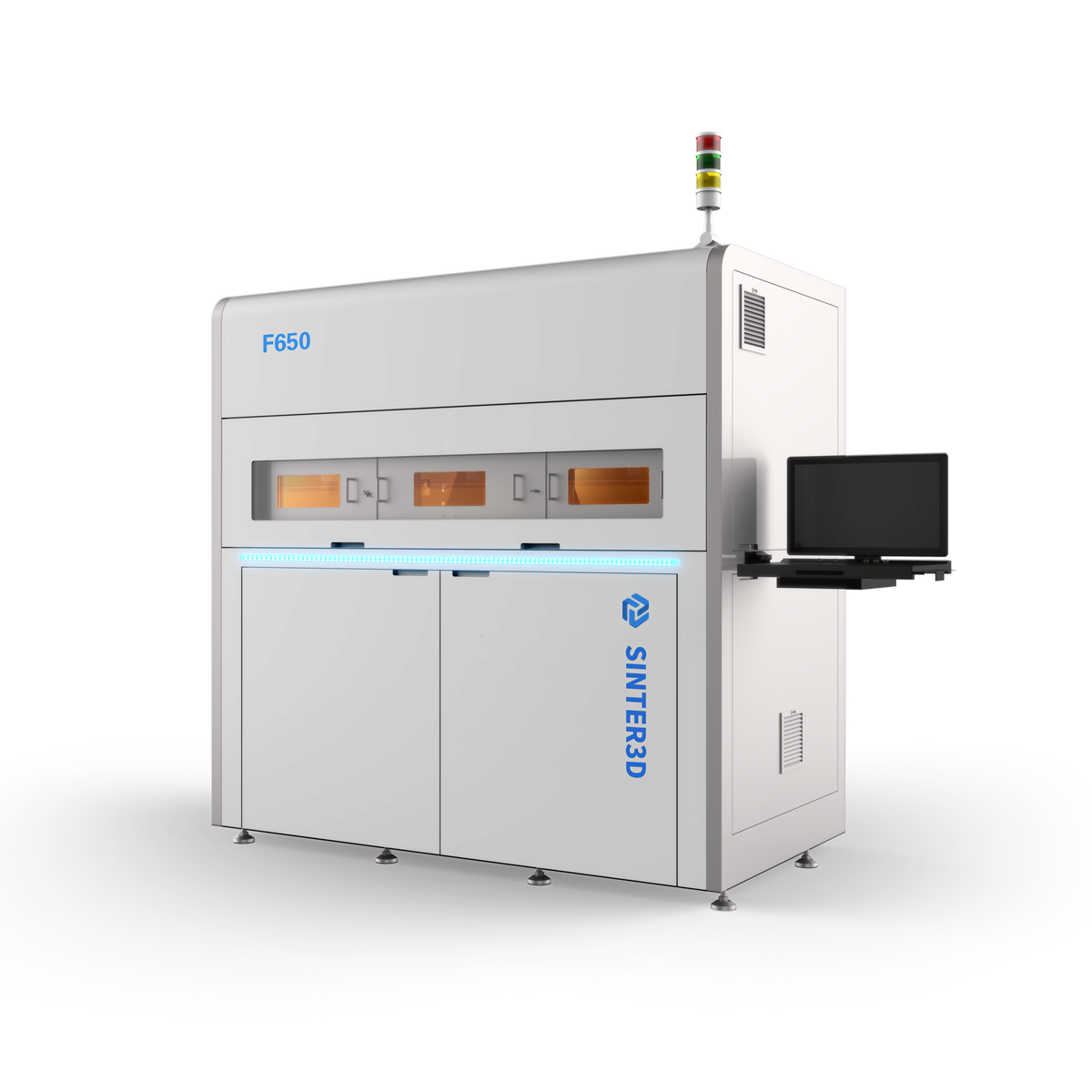
System as the entry
Industrial SLS platforms support deployable, maintainable and scalable production cells.
Sinter3D focuses on industrial polymer SLS 3D printing systems and high-performance material processes. It supports PP, PA12, PA11, PA6, TPU, PEBA, PPS, PEKK, PEEK and reinforced composites, from complex functional parts and material-process validation to low- and mid-volume production.

Sinter3D is a platform company focused on industrial polymer SLS 3D printing systems, material processes and application validation. Based on selective laser sintering (SLS / LPBS, Laser Powder Bed Sinter), Sinter3D provides polymer SLS systems, material-process development, sample validation and low- to mid-volume production support for service bureaus, industrial users, research teams and regional distribution/service partners.
Sinter3D's core R&D team is mainly composed of graduates from Dalian University of Technology, Huazhong University of Science and Technology and other well-known 985 universities in China. With PhD-level technical leadership and master-level engineers as the backbone, the team covers the full R&D and delivery chain. Sinter3D is not a simple equipment assembly team; it builds system capability around the polymer SLS forming process, including model data processing, slicing algorithms, scan-path and energy strategy, motion control, hardware control systems, laser-powder-thermal-field process development, machine structure design and production automation integration.
Companies adopt SLS not to buy a standard printer, but to build stable, controllable and scalable internal production capability. Sinter3D works around material needs, part size, nesting strategy, volume target and delivery rhythm, helping customers move from “can print” to stable production by takt.
Industrial SLS platforms support deployable, maintainable and scalable production cells.
Thermal field, powder-bed condition, scan path and sintering window turn build size and material choices into stable forming.
CO2/fiber laser routes, dual/multi-laser configurations, high-temperature platforms and parameter systems support production takt.
System capability is converted into repeatable part quality and production results customers can keep purchasing.
The Sinter3D service center is not built around generic PA12 prototype work. It starts from TPU, PEBA and other powder-bed elastomer functional parts, focusing on cushioning, rebound, fit, flexible gripping and complex lattice applications.
Use elastomers to open functional-part markets, use PPS, PEEK and other ultra-high-temperature materials to build technical depth, and build a high-performance SLS process platform in China.
A powder-bed elastomer 3D printing service center for validating high-value functional part demand from end users.
TPU and PEBA require stronger process engineering than generic PA12 work, creating differentiated functional-part capability.
We do not compete with equipment customers in generic PA12 prototype jobs; we provide difficult-process support as a complementary platform.
PPS, PEEK, PEKK and other ultra-high-temperature materials extend the platform from elastomers to engineering plastics and high-performance polymers.
Advanced customization, limited releases, multi-style accessories, footwear components, sports equipment and industrial flexible parts need a more flexible elastomer manufacturing route. It must support small-batch products that care about detail, hand feel, color and surface quality, while also moving into stable batch delivery when demand increases.
Sinter3D works with TPU powder-bed elastomers across 65A-95A hardness, PEBA and other elastomer materials to support complex surfaces, fine textures, flexible tactile response, dyeing effects and stable delivery. For high-end low-volume products, it helps customers produce multiple styles quickly; for scaled applications, it can plan build size, production takt, automated post-processing and multi-machine production cells around the target output.
This is not a single-material printing service. It is a high-performance SLS manufacturing capability for elastomer products.
Choose the system by material, build size and production workload.

200 x 200 x 300 mm; selected models 200 x 200 x 250 mm
For material testing, education, application validation and small functional parts.

450 x 450 x 400/600 mm
For service bureaus, small-batch production and industrial functional parts.
Current focus: PP, PA12, PA11, PA6, TPU, PEBA, PPS, PEKK, PEEK and reinforced composites; TPU powder-bed elastomers cover a 65A-95A hardness range.
100% PA12 reused-powder printing capability demonstrates powder reuse, no-nitrogen printing, thin and slender structures, and process stability.
PPS dynamic samples demonstrate high-temperature polymer SLS process validation capability for temperature-resistant, flame-retardant, insulation-oriented and complex functional-part projects.
Real PEEK printed parts show complex surfaces, perforated structures and lattice capability, with continued development for practical industrial parts.
Used to explore titanium alloy cold powder sintering (Cold Metal Fusion, CMF) forming and complex metal structures.


Application notes on SLS process, PPS and PEEK high-temperature materials, powder-bed elastomers, new-energy insulation structures and industrial validation parts.

SLS is more relevant to complex structures, support-free forming, low-volume production, multiple variants, functional-part production and material-process validation; for simple large parts or very high-volume commodity plastics, it is better evaluated together with traditional routes.
PPS, PEEK and PEKK are often linked to high-temperature, flame-retardant, insulation, complex-structure and high-failure-cost applications, where SLS can help evaluate material, structure and application fit at an early stage.

New-energy insulation validation often involves multiple variants, tight schedules, complex structures and high testing cost. PPS provides a material basis for temperature resistance, flame-retardant and insulation-oriented applications, making SLS useful for low-volume validation and complex-structure trials.

For advanced customization, limited releases, footwear, sports equipment and industrial flexible parts, Sinter3D builds elastomer SLS capability from multi-style low-volume production to stable batch delivery.

Presenting polymer SLS systems, material samples and industrial application capability.
100% PA12 reused-powder printing capability demonstrates powder reuse, cost control and process stability for application evaluation.