Industrial system platform
Designed for continuous production, mechanical stability, thermal-field consistency and long-term operation.
Sinter3D focuses on laser powder-bed advanced manufacturing systems, process-control capability and polymer SLS application platforms. We connect LPBS (Laser Powder Bed Sinter) systems, LPBS process control, material-process validation and sample application support.
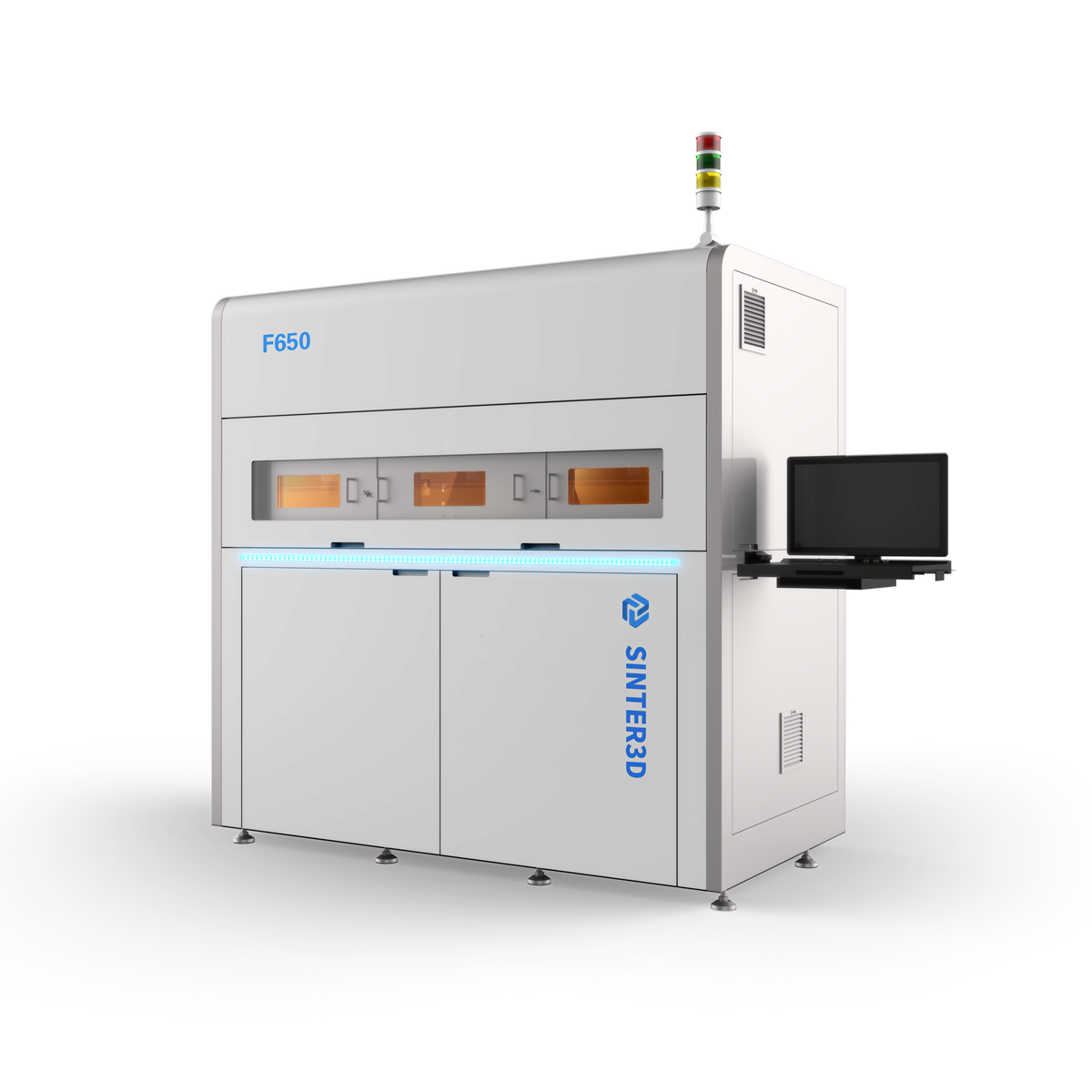
Companies adopt SLS not to buy a standard printer, but to build stable, controllable and scalable internal production capability.
For enterprise applications, Sinter3D defines an SLS production takt around the customer’s material needs, part size, nesting strategy, volume target and delivery rhythm. Based on industrial system platforms, thermal-field control, CO2/fiber laser routes, dual/multi-laser configurations, high-temperature platforms and process-parameter systems, Sinter3D helps customers move from “can print” to stable production by takt.
Configurable build-size capability is not simple non-standard modification. It is the external result of underlying engineering capability. When SLS build volume changes, thermal field, mechanical stability, scan path, powder-bed condition and material sintering window all change. Sinter3D configures suitable build spaces on mature industrial platforms, reflecting thermal-field control, platform stability and process depth.
The system is the entry, process is the core, parameters are the barrier, validation builds trust, and applications are the exit. Sinter3D delivers not just “can print”, but repeatable production results customers are willing to keep purchasing.
Designed for continuous production, mechanical stability, thermal-field consistency and long-term operation.
Supports stable forming across build sizes, material systems and nesting strategies.
Covers CO2/fiber laser routes, high-temperature platforms, TPU, PA6 and high-performance material applications.
Configures efficiency around customer production takt rather than fixed machine rhythm.
Sinter3D connects system platforms, material processes, process control and application support so customers can move from application validation to stable production.
200, 450 and 650 Series polymer SLS systems for material validation, service bureaus, low-volume production and industrial functional parts.
Powder spreading, thermal field, scan path, beam control, atmosphere control and parameterized process packages form the basis for stable applications.
Ongoing work across PA series materials, TPU and PEBA elastomers, PPS, PEEK, PEKK and reinforced composites.
Sample validation, process discussion and system-selection support help customers evaluate value and application fit first.
Sinter3D builds system capability across software, hardware, laser process, motion control and material applications, connecting equipment development with process delivery.
Motion control cards, galvanometers, PLCs, oxygen sensors, system software and production-management interfaces form the control foundation.
Continuous development around multi-galvo operation, multi-beam collision avoidance, beam shaping and dynamic scan strategies.
Equipment, materials, parameters and sample validation are accumulated into reusable process capability, not just delivered as a single machine.
A team section should not stop at titles. It should explain why customers can trust Sinter3D to connect systems, materials, process and shop-floor delivery.
Development around motion control, system software, production-management interfaces and process records helps systems move from operation to manageable and traceable production.
System design around powder spreading, thermal field, atmosphere, powder handling and machine stability connects printers, post-processing equipment and shop-floor workflow.
Sample validation and parameter development continue across PA series materials, TPU and PEBA, PPS, PEEK, PEKK and reinforced composites.
The point is not history for its own sake, but how laser, motion control, software and process capability are transferred into the SLS platform.
The technical path comes from early SLS and industrial-control experience, building a system logic that connects control, software, mechanics, materials and process capability.
Experience across selective laser sintering, laminated object manufacturing and selective laser melting supports the transition from laser processing to additive manufacturing systems.
SLS systems, materials, parameters and application validation are connected into a process loop, moving from machine development to platform capability.
PPS and PEEK and other ultra-high-temperature polymer SLS systems and process validation build technical depth for high-performance material applications.
A customer buying an SLS system is buying more than a machine cabinet. The real value lies in material handling, thermal control, powder spreading, scan strategy, parameter development and sample validation. Sinter3D connects system capability with application validation to reduce trial-and-error cost and improve project certainty.